
Companion Plants
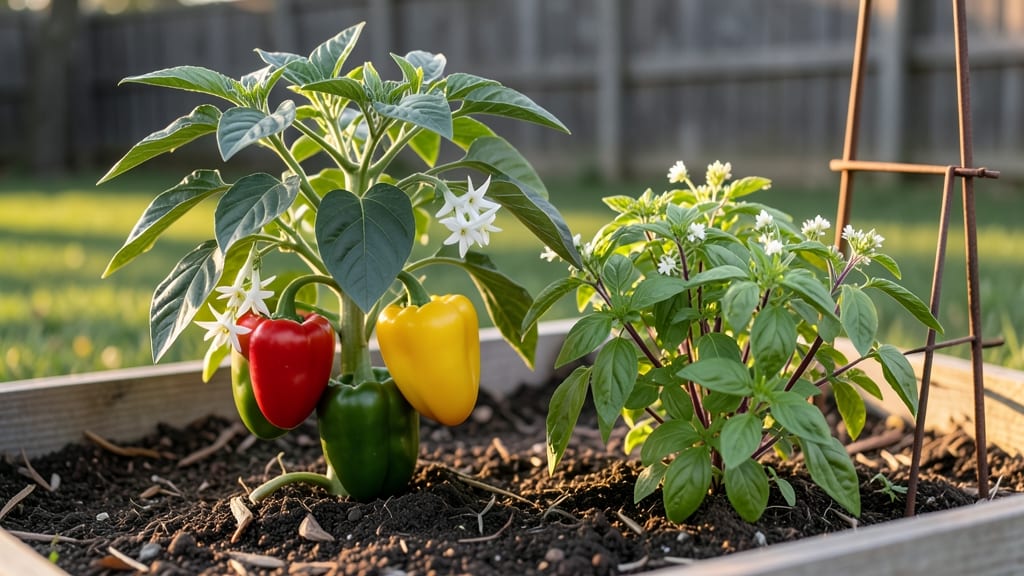
This dynamic duo works because basil's strong scent confuses pests that target peppers, while its nitrogen-rich roots improve soil fertility. 🌱 The aromatic compounds released by basil also subtly elevate the peppers' natural sweetness, making them more flavorful.
I've seen firsthand how pepper plants surrounded by basil produce thicker walls and fewer damaged leaves, especially in organic gardens where chemical pesticides aren't an option.
For best results, plant basil on the north side of pepper plants to avoid shading them while still benefiting from its protective properties. This arrangement lets both plants get adequate sunlight while maintaining their natural pest-repelling synergy.
The key is monitoring their growth—if basil starts to sprawl too much, simply trim it back to maintain that 12-18 inch spacing.
💡 In This Article
- Why Basil and Peppers Make a Great Garden Pair
- Optimal Spacing and Planting Layouts for Basil and Peppers
Why basil and peppers make a great garden pair
Basil and peppers form one of gardening's most effective natural pest control systems.
The secret lies in basil's volatile organic compounds—like linalool and eugenol—which mask the scent of pepper plants, confusing pests like whiteflies and aphids that would otherwise target them. 🌿 Studies show that these aromatic compounds disrupt the pests' ability to locate host plants, reducing damage by up to 70% in shared beds.
The effect is particularly strong against soft-bodied insects, which are drawn to peppers' tender foliage.
Beyond pest protection, basil improves soil quality through a process called nitrogen fixation. While basil itself isn't a nitrogen-fixing plant, its roots release organic compounds that stimulate beneficial soil microbes. This creates a microclimate where pepper roots can more efficiently absorb nutrients like phosphorus and potassium—essential for fruit development.
The result? Peppers develop thicker cell walls and higher concentrations of capsaicin (the compound responsible for heat), making them both more robust and more flavorful.
What makes this pairing especially clever is the flavor enhancement effect. When basil grows near peppers, the aromatic compounds in the air subtly infuse the pepper fruits during their growth cycle. This isn't just about adding basil flavor—it's about enhancing the peppers' natural sweetness and complexity.
Gardeners often report that peppers grown with basil have a more balanced heat profile, with less bitterness and more depth. The effect is most noticeable in varieties like jalapeños and serranos, where the heat can sometimes overwhelm other flavors.
There's also a physiological benefit for the pepper plants themselves. Basil's dense foliage creates shade at the base of pepper stems, reducing soil temperature fluctuations that can stress pepper roots.
This microclimate effect is particularly valuable in hot climates where soil temperatures can exceed 90°F, which inhibits pepper root growth. The cooler, more stable soil environment helps peppers allocate more energy to fruit production rather than stress responses.
One fascinating aspect often overlooked is how this pairing affects plant hormones. Basil releases a compound called jasmonic acid, which acts as a natural signaling molecule that primes pepper plants for pest attacks.
When whiteflies land on pepper leaves, the plant's defense responses are already partially activated, making it harder for the pests to establish colonies. This hormonal priming effect can reduce early-season infestations by up to 40%, giving pepper plants a head start in their development cycle.
For organic gardeners, this combination is particularly valuable because it reduces the need for chemical interventions. The aromatic synergy between basil and peppers creates what botanists call a "push-pull" system—basil pushes pests away while the peppers' natural defenses are pulled into higher gear.
This dual-action approach means fewer damaged fruits and higher overall yields, especially in small-scale or home gardens where space is limited.